







In my travel quest to find out as much as I could about Ohio’s role in the Revolutionary War, my travel colleagues and I took to the road to tour Ft. Laurens, located in Tuscarawas County in Bolivar, Ohio.
If you have a thirst for history, I suggest you take this tour that will open your eyes to details about the Revolutionary War you never knew. If you know of an educator who is taking the time and doing the work to tell their students the reason we had a war and the reason it was so important, please praise them!
If you are unable to take the tour physically, go along with our team and discover bits of new history that will make you appreciate your heritage.
The Revolutionary War was fought between Britian and 13 of its North American colonies, beginning in 1775. Two issues were central to the colonies’ rebellion: taxation and Britain’s refusal to allow colonists to settle in the Ohio Country.
In October 1778, a force of 1,200 regulars and militia led by Brigadier General McIntosh departed Pittsburgh with the intention of attacking Wyandot settlements on the Sandusky River and eventually capturing Fort Detroit. By November, McIntosh had reached the Tuscarawas River, where he ordered the construction of Fort Laurens.
They built the four-sided, star-shaped fort out of local timber. It was named after Henry Laurens, the president of the Second Continental Congress. With supplies running low, McIntosh decided in December to return to Pittsburgh, leaving 19 officers and 152 men of the 13th Virginia Regiment to hold the fort.
When the British learned of the fort and that some of the troops had departed, Simon Girty was sent to scout the location. He was too late to intercept the supplies but successfully ambushed the escort as it returned to Pittsburgh. Two Americans were killed, four were wounded, and one was taken prisoner. Girty brought the prisoner to Detroit and requested that British regulars be assigned to help take the fort. Captain Henry Bird of the 8th Regiment and a small number of regulars volunteered to accompany Girty to the Wyandot village of Upper Sandusky, where they were joined by roughly 180 Mingo and Wyandot.
It was a very difficult winter for the 150 troops left behind at Ft. Laurens. They did not have enough clothing or food. Morale was very low. Once they were ambushed by the Native Americans while some of them were out foraging for food. They were being watched but had no choice.
The siege of Fort Laurens began on Feb. 22, 1779, when a work party was surprised outside the fort by the 180 Mingo and Wyandot warriors led by Simon Girty. Seventeen were killed and immediately scalped while two were taken prisoner.
The troops were tricked into believing there were many more American Natives than there were and, believing they were heavily outnumbered, remained within the fort. Their supplies were dwindling and without hunting or gathering food, they resorted to boiling their shoes and eating the soup and leather. (Studies have proven there is no nutritional value in chewing on leather boiled in water!) According to the firsthand account of one of the troops, Captain Benjamin Biggs of the 13th Virginia, “The siege lasted 4 weeks, provisions exhausted; finally for 3 or 4 days had to live on half a biscuit a day—then the last two days washed their moccasins and broiled them for food, and broiled strips of old dried hides.”
The men were met with American reinforcements after four weeks, and Colonel Brodhead had replaced McIntosh, who soon decided Fort Lauren’s location was unsustainable and ordered the fort abandoned in August.
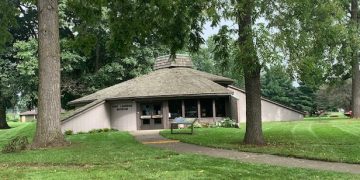
The Ft. Laurens Museum was built on top of a portion of the old fort, but this fact was not discovered until excavation work in the 1970s. I knew current archeological digs were taking place at the museum site, but I was thrilled to discover the men were hard at work as we walked onto the grounds. Only a cut-out mark lined with mulch showing the footprint of the fort remains today to show visitors the size of the old fortification.
I had read that archeologists from the Ohio Historical Connection (formerly called Ohio Historical Society) were trying to recreate the outline of the fort as well as uncover any artifacts from the area. Imagine my surprise when we arrived to find them hard at work. They were putting away their equipment for the day, so I ran with my companions to their site and told them why I was there and asked if could interview them. They were more than happy to do so and let me take pictures. I happen to find them on their last few minutes of their last day until next year. What a great moment!
According to the fort’s website, anything that remained of the fort’s east wall was destroyed in 1832 during the construction of the Ohio and Erie Canal. Excavations revealed the fort’s outline and located the fort’s cemetery in 1972-73.
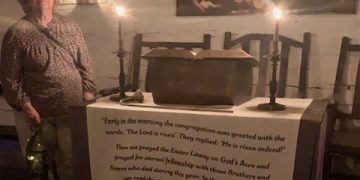
In 1986 and 1987, the remains of the soldiers killed on Feb. 22, 1779, were recovered from a mass grave. One of the soldiers was laid to rest with full military honors at the site’s Tomb of the Unknown Patriot of the American Revolution. The remains of the other murdered soldiers were placed in a crypt in the museum’s wall. A grant in 2024 helped begin the new excavation.
The museum will be closed for the year on Nov. 15 but will reopen in May on weekends. Their hours and open days can be found on their website. Adults, 18 and over, are $6. You can purchase a combo ticket to Ft. Laurens and Zoar Village, 3.5 miles away, for $15. Allow 1 ½-2 hours for the Ft. Laurens video presentation, touring the museum exhibits and the grounds.
You might want to take advantage of the trailhead for the Ohio and Erie Canal Towpath Trail close by as well as a park and picnic shelters. Ft. Laurens Musuem is located at 11067 Ft. Laurens Road, NW, Bolivar, Ohio, 800-283-8914.
We, at the Jefferson Historical Society, will be creating displays and exhibits for the Revolutionary War Exhibit for Veterans Day that will run for two weeks in November. It will include mannequins dressed as colonists, British soldiers and Native Americans. You will view a miniature fort, equipment, Indian artifacts and village. There will also be boards listing information on all 54 Revolutionary veterans identified and buried in Ashtabula County cemeteries. Come see Ft. Laurens on exhibit!


