










Just a few years before Ashtabula County was settled, a village was developed in Tuscarawas County that was a mission outreach to the Delaware Indians. Founded in 1772, Schoenbrunn Village was the first Christian settlement in Ohio. German Moravian missionaries, led by David Zeisberger, saw a need to reach the Indians with the gospel message of Jesus Christ. They chose an area that, surprisingly, was neutral in a hot bed of growing rebellion just before the outbreak of the Revolutionary War.
In this series of “Finding Our Roots,” I felt it was important to tour the restored village and learn more about what happened there. Several weeks ago, I was able to explore the village during a special fall event called, “Lantern Tours of Schoenbrunn Village.” The restored village is a reminder of the conflict of peace and war throughout all generations.
The Moravian missionary, Zeisberger, with just five Indian families who were recent converts to Christianity, traveled down the Tuscarawas River from Pennsylvania to find a suitable area to establish an Indian mission. It was a risky, dangerous adventure they felt called to make. They had been invited to establish a mission in the Ohio country by Delaware Indian leader, Netawatwes, and at his request they came and chose the site that became Shoenbrunn Village, near today’s New Philadelphia, Ohio.
My first thought when learning that the group was invited by a Delaware Indian leader was the question of how the Indian came to know Christ without any outside influence that we know of. My only conclusion would be based on the Scripture, Romans 1:12 “For since the creation of the world, God’s invisible qualities – his eternal power and divine nature-have been clearly seen, being understood from what has been made, so that people are without excuse.”
What we do know is that the missionaries established a substantial village having Ohio’s first church, schoolhouse and a civil code. No alcohol or dancing was allowed, and the Lord’s Day was strictly observed. The group was progressive when it came to education. Males and females attend school.
The village prospered for five years with the Delaware Indians and the missionaries living together in harmony and peace. They had beautiful gardens, log homes, a bakery, blacksmith, weavers, their own herb medicines, a cemetery and all the necessary needs for living.
After five years of flourishing, the British and the Indians who fought with them brought pressure upon the village as well as pressure from white settlers who eyed them with suspicion as possibly aligning with the Patriots.
The group tried to remain neutral to avoid conflict, but instead, both the British and the colonists distrusted them. It must have been an agonizing decision, but seeing they were caught between two warring factors and living in the middle of where the conflict was growing, the group made the choice to abandon the village. Most of them moved to Canada. They dismantled their homes and church as they left.
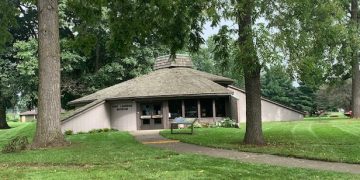
In the 1920s, efforts began to restore Schoenbrun Village using Moravian diaries and historical records to locate the site. Today, of the original 60 cabins on the site, 16 had been rebuilt, not restored. The church has also been rebuilt and the gardens and cemetery have been restored. Through the efforts of the Tuscarawas County Historical Society, the rebuilding has taken place as well as adding a visitor center with museum.
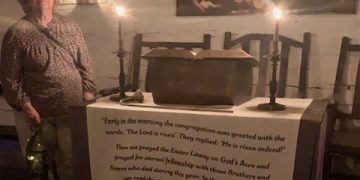
When I learned that the village hosts a nighttime Lantern Tour of the site, I made plans to go. What an event it is! Hundreds of guests were given an old-fashioned lit lantern, one per family, to light our way throughout the rebuilt village. Hundreds of lit luminaries light the path from one stop to the next. It is a beautiful sight!
Nearly every building had an activity going which would have taken place during the time the missionaries and the Indians lived there. Candle making, herb gathering, canning, baking, weaving, forging iron, and wood working were taking place. Most impressive was the simple church interior. It seemed such a spiritual place, and I marveled at those who had worshiped there with courage and commitment.
We moved up the hill to the old cemetery walking carefully between the two rows of luminaries that lined our path. We tried to read some of the stones, but of course, they were hardly legible. Scores of volunteers manned each stop, the cabins, museum and gift shop.
Our last stop was the rebuilt school where we enjoyed cider and donuts and gathered with other guests to visit much like the Indians and missionaries once did. Not knowing each other at first, we fellowshipped in peace and harmony just as those early villagers did.
We, too, look for peace and harmony in this world, but I know that the truth of that Scripture that led the Delaware Indians to the knowledge of the true God, Jesus Christ, is the only way to peace.
Schoenbrunn Village is open Wednesday through Sunday, Memorial Day through Labor Day. It is open for weekends in September through October if you want to plan a trip next year. Admission is $8 for adults, $6 for seniors and $4 for children, 7-17. The address is 1894 East High Avenue, New Philadelphia, Ohio. At the same time, you may want to visit Ft. Laurens and Zoar Village, which are close by.


