





Two years ago, I was covering the life and travels of Johnny Appleseed for the Jefferson Gazette. While staying at an Airbnb, the host invited me to witness the following morning the placement of a new metal marker for the Greenville Treaty line that ran through her property.
I have spent the last 25 years studying Ohio history and specifically, Ashtabula County history, and yet, I had never heard of the Greenville Treaty. The following morning, participating in the ceremony were historians, several news media folks, road department personnel, writers, and others. What I learned that day about the Greenville Treaty has completely altered the way I look at our state and county history, and I vowed to one day write the story of the 1795 treaty between the Indians and the United States government.
This past week, I toured Fort Recovery where the signing took place. The fort was abandoned in 1796 and the town of Ft. Recovery was built around the restored fort and museum. We also toured the Garst Museum in Greenville with its exhibit, Crossroads of Destiny, “dedicated to telling the story of the Indians and the white man as they battled for the land that would become Ohio.”
On the first night of the trip I titled, “Indian Trails and Revolutionary War Forts,” our crew of three had the privilege of witnessing the live outdoor drama, “Tecumseh,” telling the story of the Shawnee chief who fought to keep Ohio land. He had been born near today’s Chillicothe. Labeled as the most mesmerizing drama in the nation, the 2.5-hour presentation takes place on Sugarloaf Mountain in their amphitheater just outside of Chillicothe. For 49 years, this production has told the story of the Indians’ struggle to keep their land in Ohio. Tecumseh wanted to make and keep peace with the white settlers and did all he could to achieve it, but he could sense deception.
He knew the only way to stand against invasion and removal was for the tribes to become as one. He traveled for ten years among the tribes, encouraging them to set aside differences and unite in order to stand against the government. But most would not relent and argued against his idea.
More than 100 people help put the production on that is based on the books by Pulitzer and Emmy-award-winning author Allan W. Eckert. Two-and-a-half-million people have watched the live production on the side of the mountain, which includes horses racing down beside you, Indians crossing the creek in canoes, British and white settlers marching through, Indian councils gathered around campfires, and cannons and rifles going off, all adding to the reality of the show.
I learned that Tecumseh made friends of a white settler and his family, the James Galloways, as well as fell in love with the daughter, Rebekah.
He visited them when in the area for years and was given a Bible by Mr. Callaway from which he learned to read and speak English. After asking Rebekah to marry him, she replied only if he gave up his Indian culture and lived as a white man. That was something he could never do, and he left, telling her she would never see him again.
The rest of the production centers around Tecumseh’s travels and meeting with other tribes, his struggle with his brother, named “the Prophet,” and battles. It was one of the most thrilling dramas I have ever experienced and will never forget. You will learn and understand the Indians’ struggle in a way a book cannot bring out adequately.
You can watch a one-minute trailer of the production on YouTube or attend it live by purchasing tickets to the nightly show. Tuesdays are family days on which you can get a half-price ticket. It is a family show and one I hope you will take advantage of.
The 1795 Treaty of Greenville ceded to the United States the southern two-thirds of what is now Ohio. Tribes present at the signing were the Chiefs of the Miamis, Delawares, Ottawas, Eel River, Weas, Kickapoos, Shawnees, Chippewas, Wyandots, Potawatomis, Piankashaws, and the Kaskaskias.
Meeting at Fort Recovery, the chiefs brought many of their tribe with them. They encamped around and in the fort. More than 1,130 Indians set up camp to stay and witness the signing. But missing from the signing was Tecumseh.
All hostilities were to cease. Indians were given $20,000 at the signing and were promised $9,500 in goods annually. General “Mad” Antony Wayne used language they would identify with and promised them that as “children of the Fifteen Fires” (the United States), they would be under “the protecting wings of her eagle.”
The United States gave up “their claims to all other Indian lands northward of the Ohio river, eastward of the Mississippi, and westward and southward of the Great Lakes.” The Indians were “quietly to enjoy” this land “so long as they pleased.” It was pure deception by the United States government and a betrayal of the trust the Indians gave the “white man” in order to live in peace.
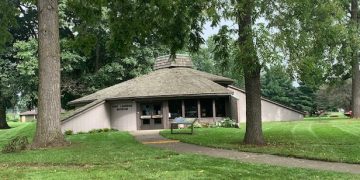
When I toured the grounds and buildings of the restored Ft. Recovery, I tried to imagine such a large group of Indians in one place. It is now a peaceful park with historical markers telling the story of what happened in that almost sacred place. Such hopes were dashed there.
I passed by the Greenville Treaty round metal marker that rests flat on the ground within the fort. These markers have been placed all along the Greenville Treaty Line that first divided the southern part of Ohio from the northern part. The Indians were agreeing to vacate the southern part and live only in the upper part of Ohio.
Little did they know what they were actually agreeing to. It was just as Tecumseh predicted. Other treaties would be signed by the Indians that would continue to rob them of their land. The Indians were given lots of whiskey and promises of peace and land. Outnumbered and defeated, the Indians would sign, hoping the United States would keep their promises. We did not.
It was after the 1795 signing of the Greenville Treaty that surveyors for the Connecticut Land Company came to what would become Ashtabula County and divided the land into lots which were then sold. The first actual white settlers then came to the shoreline of Lake Erie and on to Harpersfield in 1798 to establish the first white settlers of our county.
From sheer undeveloped wilderness, this area became so populated and spread across Ohio that there were 60,000 people living in Ohio when she became a state in 1803. It had been just four years since the Harper family settled in Harpersfield and beyond.
In early 1812, Tecumseh was still trying to hold onto the land. With the support of the British from Canada, he fought and overtook the American forces at Fort Detroit, but was attacked the following year at the Battle of the Thames where he was shot and killed. Without the great warrior heading the tribes, many of them disbanded. The British deserted his people, and no one took his place to fulfill his dream of an independent Indian state.
The final Greenville Treaty was signed in 1814 with General William Henry Harrison present with the Indians chiefs. The American settlers took possession of the Ohio territory as settlers moved in and established villages and towns.
By 1830, the United States passed the Indian Removal Act which required tens of thousands of Indians to be moved out west.
Next week, you will read of the exhibit, “Crossroads of Destiny” at the Garst Museum and what Indians were still in Ashtabula County when it was settled and how the first settlers interacted with them.
Support authors and subscribe to content
This is premium stuff. Subscribe to read the entire article.


