


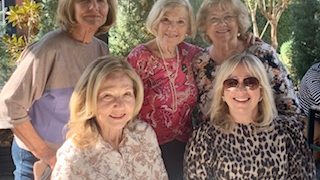
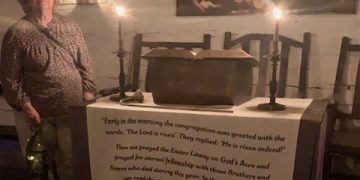


We were excited to continue our tour of the locks on the Miami & Erie Canal as we traveled down small lanes and roads, passed through small quaint villages and drove through beautiful rolling countrysides with neatly maintained farms. Many of the farms had been in the same family since the building of the canal, begun in 1845.
Few people would doggedly search out the locks like our Jefferson crew, but we were on a mission and would not give up until we had located as many as have been partially or completely restored. Leaving our cabin at West Liberty, we took along our maps, pamphlets, and hoped our GPS would not lead us astray. We have been led astray so many times by GPS, but every time we have made some great discoveries and met some amazing people, but not without some frustrating moments.
Have you ever tried to drive with three phones giving out three sets of directions at the same time? Several times, our driver had to stop and ask us to turn off our phones while she concentrated and thought. A really good cup of coffee always livens us up and helps us focus.
The town of St. Mary’s near Grand Rapids, Ohio, and the German town of New Bremen have done an outstanding job of preserving their lock and canal way. The lock at New Bremen is Lock One. If you decide to make the trip, make sure you stop at these two locations.
The weather had turned extremely windy as we crossed the canal way and as we toured the St. Mary’s Canal Park, but it was worth it to see their covered bridge and read their historical markers.
Traveling further, we found the locks at Lockington, a very small village with a few homes and their partially restored lock. The Ohio Historical Connection (formerly Society) has helped bring this lock back to partial life, although there is no water. You can pull off the side of the road to see this particular lock and walk all around it.
In the historic village of Providence located in Grand Rapids, Ohio, there are several historic buildings that have been restored as well as a well-maintained canal lock and boat which we boarded and took the half hour ride. I mentioned the “Volunteer” canal boat in part one of this series. There is a reasonable charge for the ride but more than worth it. I called ahead and made a reservation for three but learned on the way that a school group of young kids would be on our tour. The boat holds 65 people. We three would be joining about 60 youngsters.
We love kids, do not get me wrong. But this information led us to make the choice, at the suggestion of the reservation office, to drive faster and get on the boat BEFORE the onslaught of the school children…which we did!
I enjoy meeting staff workers and docents at historical sites. They are usually very dedicated, informed and love their job and this trip led us to meet some unique folks that added to our visit and made it memorable. As we left the Volunteer canal boat, I asked one of the men why he did not play the backpack guitar he was holding. He asked if we would like to hear a canal boat song, which we, of course, replied, “Yes!”
One of our Jefferson crew is a singer and joined right in humming in harmony. The singer then said he had made several CDs of canal songs he had written and asked if we would like one. As you can imagine, we played it the rest of the trip. How many readers learned the canal boat song in elementary school, “Low Bridge, Everybody Down,” by Thomas S. Allen?
We learned from the boatman/songwriter that the song is about the Erie Canal and the expression shouted out by the helmsman when the boat was passing under a bridge, warning those on board to stoop down which is exactly what we did when the shout ran out! The repeating chorus says, “fifteen miles on the Erie Canal.”
We have been singing this Ohio history song wrong. The songwriter told us the original lyrics of the song were “fifteen years on the Erie Canal,” referring to the time Thomas S. Allen worked on the canal with his mule, Sal. The lyrics were changed in 1926 to “fifteen miles on the Erie Canal” referring to the average distance a mule would pull the canal boat before needing a rest. If we had not stopped to talk with this canal boatman, we would have never the story of the song and the right words, which we took to singing the rest of the day as we travelled!
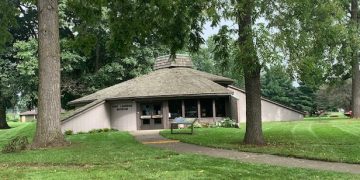
Getting in our car, we drove over to the other side of the road to the Lock 44 parking lot. This stop is free and full of history and two buildings to tour. The bright red building houses a replica of the lock, canal and boat in its heyday as well as displays of life in and around the canal. The building next door is the huge, gray restored 1849 Ludwig’s Mill where you can see four floors of mill life similar to what would have taken place during the heyday of the canal. In 1854, cholera wiped out the population of Providence and it was no longer a stop on the canal.
On the first floor was a blacksmith shop where we met an amazing woman who has been blacksmithing for 25 years. I asked her what she did before she came there and she said a police sergeant at a high security prison in Toledo. I asked her why she switched to her current job and she said she had begun to fall and could no longer protect herself or her fellow guards.
She received her injuries as a young child after falling down the stairs. She has borne the effects of the incident all her life. This woman of strength was doing an outstanding job of amazing feat. We were blessed to have talked with her and observe her work at her craft. She is dedicated, positive and an inspiration on our historical tour where we always learn more than the history of a place.
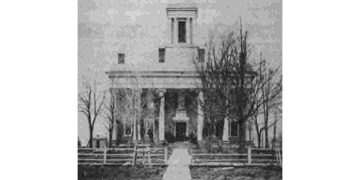
The highlight or our canal lock tour was the Johnston Farm & Indian Agency near Piqua, Ohio. John Johnston was a federal Indian Agent and settled at this site with his family in 1811. The 250-acre site includes the Johnston home, several outbuildings, animals, garden, pump house and summer kitchen all in sight of the Miami & Erie Canal.
On the property is an Indian Museum tracing the story of the Easter Woodland Indians in Ohio. You can dress up as an Indian or deer hunter in the clothing provided, see a large scene of Indian life and even take a canal boat ride next to the museum.
If you have never heard of John Johnston, you are not alone. He has been lost to time. I am so thankful to the staff at the site and all those who have sought to preserve his memory and his work. He was a strong supporter and friend of the Indians and was the first Ohio canal commissioner, 1825-1836. He performed President George Washington’s eulogy, was acquainted with William Henry Harrison, was the president of historical and philosophical societies of Ohio, helped found Kenyon College, served on the board of trustees of Miami University and was a member of the board at West Point.
A major renovation of all the buildings, property and barn have resulted in an historic site that is both unique and informative. The life of the canal, the life of the Indians, and the life of the Johnston family is told through accurate records, artifacts, buildings and the museum.
We met a docent whose love and knowledge of the place made it come alive so much we could just imagine living there in the early 1800s. It was unlike any historic site I have been because the family records, pictures and detailed information, both from the family and official records, are so extensive.
Rachel Johnston was a godly, praying woman and birthed 15 children, 14 of them living to maturity. The family Bibles are on display as well as family letters and pictures. Rachel is praised and admired by the community and family. At barely 17, she married John Johnston and left Philadelphia and its wealth to go to the wild Ohio frontier with her husband. On the land in Piqua, she worked hard, took care of her family and shared her faith with the community and beyond by raising money to buy Bibles for anyone who needed one.
On our house tour, the knowledgeable docent showed us a small space with a window, the area not much bigger than a closet but with a door. When I asked what the room was for, she said it was Rachel’s prayer room. The servants and family knew if she was in there with the door closed, she was not to be disturbed. She founded the Piqua Female Bible Society in 1817, one year after the founding of the American Bible Society.
Rachel Johnston’s story is so instrumental in understanding the Ohio frontier and the life our pioneers endured, I plan to include it in a series for our 250th anniversary of our independence next year. Her husband ministered to the nation, the Indians and his family in shaping our nation and the state of Ohio. Rachel’s story shows how she ministered to the souls of our early pioneers as well as her family but her story has been lost over time. Hopefully, when you read about her next year, you will be moved and understand our history at a greater level.
What an unbelievable journey back in time to the canal days of our state. I hope you get the chance to visit some of our locks and get to tour the Johnston Farm & Indian Agency. If you are unable to travel, you can check out all the locks and farm online by typing in Johnston Farm & Indian Agency or Ohio Locks.
Support authors and subscribe to content
This is premium stuff. Subscribe to read the entire article.


