









CONNEAUT – Two years ago, a developer contacted Growth Partnership for Ashtabula County with a request for information on potential development sites in Ashtabula County.
M2 Development Solutions provided a list of specific requirements that utility needs and property sizes.
Growth Partnership provided information on several sites, including some in Ashtabula Township and the industrial park on Conneaut’s east side. It was from that list that M2 Development Solutions chose the industrial park. The company secured a site option for the property, which was approved by city council approximately 18 months ago.
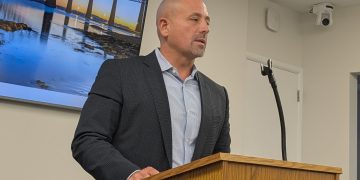
“(M2) began conducting feasibility and due diligence, which is very typical for any type of development,” Greg Myers, executive director of Growth Partnership, said during a city council work session on Monday, Oct. 5. “That work would include things like electrical power studies, that would include natural gas capacity studies, wetland delineations, geotech work, site capacity evaluations and other technical analyses that you would do on any development. The reason that you do that is you’re determining whether or not there’s suitability with those sites with the type of development that you’re considering for those locations.”
The feasibility study is then used to confirm with potential customers the developer is working with the their needs can be met. The feasibility study then goes on the investor market and the financing market to get a project financed.
Myers made it clear that M2 is still conducting a feasibility study and that there is currently no project proposal on the table.
“There is not (a project proposal) at this point because that feasibility work isn’t to a point where a project could be identified yet,” Myers said. “There’s no end user. There’s no tenant, there’s no specific facility that’s being proposed for that site at this particular time.”
Myers was also clear in stating that the industrial park, because of its characteristics, would not be utilized for an AI hyperscale data center.
“Really, the buildable acres there just aren’t enough to accommodate the size that we require to allow for that to be financially feasible,” Myers said.
Myers said other types of data center operations, an enterprise data center, for example, would be suitable for the site.
“An example of an enterprise data center would be like a hospital,” Myers said. “An enterprise data center is one that’s dedicated for a specific end user. Think of the Cleveland Clinic or (University Hospitals). They have more large-scale data centers that they use for medical records, that we all use for our My Chart. They use that for the technology that’s implemented when you’re doing telehealth visits and those sorts of things.”
“It might be a financial institution,” Myers continued. “It might be a government entity, a state or local government that would operate something like that. Or, it may be a co-location facility, and, what that is, is that there’s lots of smaller users that are renting space within the data center itself. It could be the City of Conneaut. It could be a local manufacturing company. Everybody’s using that type of data.”
Myers said that, if a project were to be proposed, it would be an enterprise data center.
M2 Development Solutions has continued conducting the feasibility study though it was aware of discussions of a data center moratorium and the formation of ad hoc committee that is discussing conditional use zoning. The developer is also aware of the ballot initiative on the charter amendment that is on the November election ballot.
The company requested an audience with city council to provide an opportunity to ask questions and present concerns.
“I think the other purpose of what they want to present to you is, again, not to seek any approvals, but to really, more importantly, open a dialogue and have a conversation around how they could work with the city and the community at-large, should a future project be determined to be viable there,” Myers said. “Specifically, (they want to have) a discussion around the commitments that can be used to ensure that any project that might be developed there is one that is in line with something that the city would be reasonable and open to. Those sorts of things that they would specifically address are things like development agreements.”
Development agreements are not unique to data center development and are agreements between the community and the developer with specific language stating that certain criteria will be met. That criteria could be a dictate that the developer supply power for the end user rather than pull power from the grid.
“That can be written into a development agreement,” Myers said. “It might be, you need to make sure that any air emissions, water consumption. Any of the concerns that are legitimately raised by the community can be addressed comfortably within that development agreement, where they’re legally bound under that agreement to commit to meeting those particular standards.”
Community contribution agreements can also be discussed. Those agreements can include improvement of infrastructure and building a new safety services building, among a myriad of other contributions that will be included in the project.
A decommissioning agreement will also be on the table for consideration.
“A decommissioning bond can be issued on the backside,” Myers said. “Let’s say the data center industry implodes and the facility becomes obsolete in 10 or 15 or 20 years, whatever that time frame is. A bond is placed on the front side to be able to have funding available to tear down that facility and have a site that can be used for another purpose.”


