




The last day of the Veterans Exhibit at the Jefferson Historical Society turned into one of the highlights of the entire week. Having inquisitive 5th graders was a delight and a challenge when 165 of them walked through the doors.
But on Saturday, we were thrilled to welcome a 55-passenger bus filled with folks looking for some answers and ready with questions concerning Ashtabula County’s very own Charley Garlick, a runaway slave who enlisted in the Civil War and returned to live the rest of his life in downtown Jefferson.
We were a last-minute tour stop addition for the group from Youngstown, led by a Youngstown State University Underground Railroad class teacher, Vincent Shivers.
We had 48 hours to prepare for their stop, so our great volunteers pulled all our resources on Ashtabula County’s connection to the Underground Railroad, John Brown, Charley Garlick, the Black Strings, the anti-slavery committee of the 1850s and 1860s and, of course, Joshua R. Giddings, well-known friend of the “colored man,” as was expressed by former slaves.
In 1902, Joseph A. Howells printed Charley Garlick’s autobiography and was getting ready to reprint it in 1912 because of the demand, but Charley died that year. Howells used the autobiography in Charley’s obituary.
In 2005, a group of Jefferson historians, including Dorothy Havens, Norma Waters, Velma King and Pastor William Offutt of the First Baptist Church of Jefferson, got together and reprinted Charlie’s story. They had help from Margery Fuller, a Black History teacher from Kent State, Ashtabula Campus, and Rev. Louis Grandberry of Ashtabula.
The group added pictures, some of Charley’s correspondence, and stories of former slaves who made Jefferson their home and included their photos.
We enlarged as many photos as we could, framed them and set them all around several tables. As the group entered and perused the materials, I shared with them a little about Charley Garlick’s life.
We had made copies of the Charley’s original autobiography printed in 1902 and gave them out. There is no copyright on either edition of the book.
Charley Garlick’s real name was Abel Bogguess. He was born about 1827 and named after his Virginia (now West Virginia) plantation owner, Richard Bogguess. He had 11 brother and sisters. Their parents were slaves on the plantation, with his mother being in charge of the house. The owner had promised the slaves their freedom upon his death, but it was not likely to happen.
Fearing they would never be freed, Charley, his mother and five of the youngest children, fled from the plantation and hid in the woods while they were pursued for several days. Charley’s mother and the young children were convinced by some relatives who came upon them that they would eventually be freed, so she took the young ones and returned. (They were not freed.)
Charley, at 16, was encouraged to try to find freedom, and he made a choice that day that changed his life. It would be 40 years before he would see any of his family again, except a brother who had left a day or two before him.
Charley’s life from that moment on would be filled with adventures, fear, danger, and eventually a new life. He would enlist in the Civil War in 1864 with the U.S. 3rd Heavy Artillery, Company G, a Colored Troops Unit tasked with guarding and protecting Fort Pickering, Tennessee, as well as the city of Memphis.
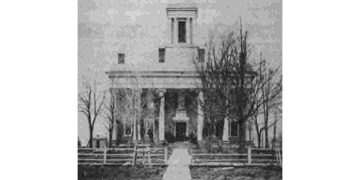
He would survive the war and return to Jefferson and life until his death in 1912. Joshua R. Giddings, known as “a friend of the colored man,” would allow him to live on his property, and after the Giddings mansion on North Chestnut Street burned in 1870, allow him to live in the law building until his death.
What happened to Charley after he escaped and how he got to Ashtabula County and the men and women who helped him makes for fascinating reading still today in 2025.
Some of our tour visitors were related to Charley through his brother, Richard Boguess Johnson, who escaped a few days before him and lived near Youngstown, Ohio.
It has been almost 100 years since Charley Garlick was born, and his story still inspires people. Today, I am covering only his Civil War service because of our nations’ focus on veterans during the month of November. In a future column, I will tell of his escape from capture several times, as well as where he lived and worked in our county.
If you are interested in seeing the autobiography of Charley Garlick reprinted, I would love to hear from you. Contact Gazette Newspapers, Inc. or email me at onesouthernwriter@gmail.com.
The 24-page 8 ½” x 11” book is no longer available. It was printed through the efforts of Pastor Bill Offut’s brother-in-law E.B. Gillham and Glenaden Press of Ontario.
Support authors and subscribe to content
This is premium stuff. Subscribe to read the entire article.


