





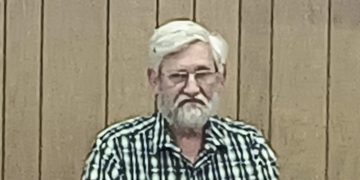
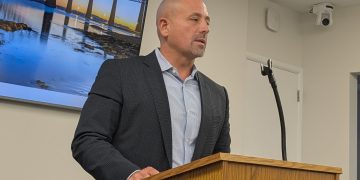






JEFFERSON – As Judge Harold E. Specht and Judge Albert Camplese campaign to be a judge for the Ashtabula County Court of Common Pleas, the pair seems to have a similar mindset as to why they want the position.
The duo also has some differing ideas as to how to accomplish their goals as far as how the Court of Common Pleas should operate.
The candidates provided answers to a questionnaire that highlight where they might be of the same mind, but also where they differ.
In Part 1 of a two-part story, Democrat Camplese and Republican Specht discuss what matters to them; what they’d like the public to understand about their perspectives; the questions they’d like to be asked by the public; and what they might have in common with others as well as where they might differ.
The candidates’ unedited answers to the questions they were asked are below.
Q: Help our readers understand what about this election matters most to you. What feels at stake or what is having the most effect right now?
Specht: This election is about experience, consistency, and the kind of judicial philosophy voters want represented on the Common Pleas Court.
I currently serve the people of Ashtabula County as Judge of the Eastern County Court, and I am proud to be the Republican candidate for Common Pleas Judge after winning the Republican primary.
As a judge, my responsibility is not to make law from the bench. It is to apply the law fairly and consistently, protect the constitutional rights of everyone who enters the courtroom, hold offenders accountable when the law requires it and ensure that victims and the public are treated with respect.
Judicial elections matter because the decisions made in our courts have real consequences for families, victims, defendants, businesses and our entire community.
Camplese: The question of whether we keep proven experience, and vast institutional knowledge, is at stake in this election. Each candidate may only serve one term due to Ohio’s age restrictions. Therefore, this race fundamentally concerns the question of who is best prepared to serve every aspect of the General Division on day one?
Both candidates have presided in matters involving traffic tickets, small claims, evictions and misdemeanor matters. Both candidates are also former prosecutors. However, I am the only candidate with full-time judicial experience (33 years). I am the only candidate who is already a Common Pleas Court judge (12 years). I am the only candidate who has judicial experience concerning child custody matters. I am the only candidate who has judicial experience concerning child support matters. I am the only candidate who has judicial experience concerning wrongful-death matters. I am the only candidate who has supervised and directed judicial magistrates. I am the only candidate who has presided as a judge in cases involving the most serious of Ohio’s felony laws.
Local tax dollars are also at stake in this election. Our county is preparing to make a major investment in a new jail. I am presently the only Common Pleas Court judge required by law to provide input into this project and we must ensure adequate jail capacity will be available to our county’s lower courts so that misdemeanor sentences can actually be served. Building a larger jail alone does not guarantee we will avoid overcrowding in the future.
Our system must distinguish among offenders who pose a danger to the community, those whose criminal behavior is driven by substance-use disorders and those whose conduct is associated with mental-health needs. Jail and prison are necessary for people who need to be incarcerated. As a General Division Judge, I will work to ensure we are not left with incarceration as being our county’s only tool.
Treatment and accountability are not mutually exclusive. Properly structured specialized dockets require treatment, testing, close supervision and repeated appearances before a judge while holding participants accountable for their conduct. We also have an interest as a community in avoiding the potentially substantial medical costs associated with incarcerating status offenders. State law requires these medical expenses to be paid by county taxpayers.
What is at stake, in my view, is whether we develop and use all tools available to protect the public. How do we reduce repeat involvement with the criminal justice system, use our jail responsibly and make responsible use of our local tax dollars and taxpayer resources?
Q: What would you like to have others accurately understand about you, your perspective and your experience as it regards the office you are seeking?
Specht: I believe my entire career has prepared me for this opportunity and has made me the best candidate for the job.
My professional life has been dedicated to the law and to serving the people of Ashtabula County. I spent years in the Ashtabula County Prosecutor’s Office, including serving as Chief Assistant Prosecutor, where I gained extensive courtroom experience and handled serious and difficult cases. I then had the privilege of becoming Judge of the Eastern County Court, where I have gained the experience that can only come from sitting on the bench and making difficult decisions every day.
I have seen our justice system from both sides of the courtroom, as a prosecutor responsible for presenting cases and protecting the public and now as a judge responsible for fairly and impartially applying the law. That combination of experience has prepared me for the responsibilities of the Common Pleas Court.
My judicial philosophy is grounded in the Constitution, the rule of law, personal responsibility, public safety, and the belief that judges should apply the law as written rather than legislate from the bench. I am a tough but fair judge and always will be.
I am not seeking this office simply because it is the next position available. My entire career has led me to this moment. My education, my years as a prosecutor, my courtroom experience, and my service as a sitting judge have prepared me for the responsibilities of the Common Pleas Court.
I believe I am the best candidate for this job because I have the experience, temperament, work ethic and understanding of our local justice system necessary to serve Ashtabula County effectively from day one.
Camplese: I bring an unmatched breadth of experience and institutional knowledge to this office. Before taking the bench, I served as a law clerk to three judges, established my own law practice and worked as a prosecutor. In 33 years on the bench, I have presided over nearly 250,000 cases.
My current responsibilities extend well beyond deciding cases. I administer both the Probate and Juvenile Courts, including 39 employees, two facilities, budgets and programs. Throughout my public service, I have been responsible for recovering public funds, reducing government expenditures, avoiding unnecessary costs and securing outside funding – including the recovery of $1.2 million while serving as a prosecutor in the early 1990’s.
That experience has shaped my perspective. A judge must be independent, prepared and fair. A judge must protect public safety and hold people accountable but must also have the judgment to recognize that every case and every person appearing before the court is different.
I have spent my career trying not merely to process cases. I have identified problems and developed practical and cost-effective solutions to them. Most importantly, I have used federal, state and private foundation monies to solve our problems. This is the experience and perspective I bring to the General Division.
Q: What questions do you wish others would ask you?
Specht: I wish more voters would ask judicial candidates about their judicial philosophy and their actual courtroom experience.
How do you interpret the role of a judge? How do you balance accountability, rehabilitation, public safety and the rights of the accused? How do you manage a courtroom efficiently while still giving every case the attention it deserves?
Those questions matter because judges make difficult decisions every day. Voters deserve to understand the principles and experience a candidate will bring to those decisions.
Camplese: Who has the most directly relevant experience to be a Common Pleas Court judge? What kinds of Common Pleas cases have they handled? What responsibility have they had for administering a Common Pleas Court? Has the candidate previously been responsible to supervise and direct the work product of magistrates?
Does the judge approach each case independently? Does the judge listen? Does the judge treat people with dignity and respect? Is the judge willing to make an unpopular decision when the facts and the law require it? Does the judge understand that accountability and fairness are not competing values?
Judges exercise extraordinary authority over people’s liberty, families, property and futures. Those are the important questions to ask of anyone seeking this responsibility.
Q: What values do you imagine you have in common with others; where might you differ?
Specht: I believe most people in Ashtabula County share some fundamental values: safe communities, personal responsibility, equal treatment under the law, respect for law enforcement and victims, protection of constitutional rights and a court system that works efficiently.
For me, one of the most important responsibilities of a judge is protecting the public. The safety of our families, our children, our seniors and the most vulnerable members of our community must always be taken seriously.
I have been very clear about where I stand: “Abuse of women, children, the elderly or animals will not be tolerated under my watch.”
My judicial philosophy reflects conservative principles regarding the Constitution, the rule of law, accountability, public safety and the proper role of the judiciary. I believe people who commit serious crimes must be held accountable, while also recognizing that the law provides opportunities for rehabilitation in appropriate cases.
Where people may disagree politically or philosophically, my responsibility as a judge remains the same. A courtroom cannot have one standard for Republicans, another for Democrats, and another for independents. There must be one standard: the law.
Camplese: I believe I share with most people some very basic values: we want safe neighborhoods, good jobs and opportunities for our children. We want people who work hard to have the opportunity to build a good life and raise a family here. We expect people to accept responsibility for their actions and we expect government – including our courts – to use taxpayer resources responsibly.
Those values have influenced the way I have approached Juvenile Court. I learned that if we wanted young people to become productive adults, simply punishing them after they got into trouble was not enough. We also had to address the reasons they were failing and help prepare them to succeed in school, employment and eventually in the workplace. That was one of the principles behind the programs we developed through the Juvenile Court and Family Resource Center.
The same experience influences how I view the criminal justice system. People who commit crimes must be held accountable and people who pose a danger to the community may need to be incarcerated. But addiction, mental illness, lack of education and lack of basic employment skills can also contribute to repeated involvement with the criminal justice system. Where those problems can be addressed safely and effectively, I believe we should address them rather than simply wait for the same person to return to court.
Where I may differ with some people is not in the importance I place on accountability or public safety, but in my belief that accountability alone is sometimes not enough. A sentence should address the offense before the court, but when appropriate it should also reduce the likelihood that the person will commit another offense.
For me, this is ultimately about the kind of community we leave to the next generation. I grew up here, built my career here, raised my family here and have spent my adult life serving this community. I want Ashtabula County to be a place where our children and grandchildren can find opportunity, build productive lives and choose to remain.
Note: Part Two will run next week.


