



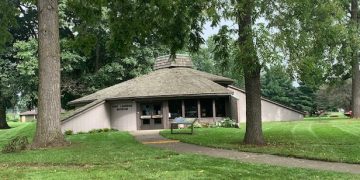


ASHTABULA TOWNSHIP – More than two decades ago, a competition was created in an attempt to get Ashtabula County’s high-school students into local parks and to look closely at everything that surrounds them.
The Botany Competition encourages students from the area’s high schools to work together to identify plants as they’re guided through Indian Trails Park by a master gardener.
Students from Edgewood High School took their turn in the competition on Friday, May 8.
“This started before I started, 25 years ago, and the idea was to get them out into the parks in the local area, and also to get them to appreciate what’s there, and start looking at things specifically, the minutiae, and working together as a group,” Pat Seymour, a Master Gardener who assists in the coordination of the competition, said. “Things change, so all the high schools, more or less, became involved.”
Students from each of the county’s high schools have to work as a team to identify as many of 37 plants selected plants as they can.
“The Master Gardeners started becoming actively involved about 10 years ago and we added a couple things,” Seymour said. “We’ve added on the idea of a practice session. That way, even though the teachers prep the kids, some of them, most of them, are science teachers. They prep the kids. Some of them don’t have time to do that. We offer services to go out and prep the kids.”
The Master Gardeners have a number of goals when it comes to the students’ experiences.
“The intent really is this – get them outside, because they’re never outside; get them to appreciate what’s around, because a lot of them never visit this park; appreciate the idea of working in groups, because they have to work in a small group and exchange information and not rely on one person who might know it all; and to get their identification skills, because those are important in life,” Seymour said.
The Master Gardeners select and mark the plants to be identified prior to the start of the competition.
“Another Master Gardener and I come out, we identify the plants, we use a book called ‘Newcomb’s Guide,’” Seymour said. “It’s similar to a dichotomous key. In other words, if you start and really are very specific about looking at a flower piece, looking at the leaf, looking at some of those specifics, it’ll key you down within a pretty specific area. In addition to that, they have to note the Latin name, as well as the common name. They are able to use a book. They don’t have to memorize this. There’s about 30 different plants (they have to identify).”
The Master Gardeners attempt to get the students to immerse themselves in the environment and truly enjoy their surroundings.
“We definitely have seen the kids become engaged in some of it,” Seymour said. “A lot of times, what I do is I just say, ‘Okay, so it might be a rainy day, but it’s still going to be pretty.’ I want them to really engage with what’s around them, to look. It’s trees, it’s down low, it’s whatever, and I think they do appreciate it when they leave. I always ask them what they think, was it good?”
To identify the plants, students have to get up close and personal with the plants.
“Then, the idea of the group work, and since we’re having them use loupes, which are magnifiers, those magnifiers have to be up close and personal,” Seymour said. “(The loupes) have to be within an inch and a half of their eye and about two inches of what they’re looking at. I had girls yesterday. It was really interesting. They weren’t going to do that, because you have to get down on your hands and knees. They got down, and the two of them go, ‘Oh, wow, this is so cool,’ because what they saw is something that you can’t tell from (standing over it). I think that’s important. It’s just something new, and a different way of looking at things, and working together as a group.”
There’s a value in being able to identify the plants in the parks of Ashtabula County.
“We’re able to stress, if we’re with the kids in a practice session, some of these plants are native, and the majority of what they’re identifying will be, but there’s also several of these that are non-native and a good three to four that are invasive,” Seymour said. “If I have time with them to show them what that invasive property looks like, I have done that. We don’t always have time, especially if they’re here for the competition.”
“These areas are being strangled, literally, by a couple different plants and they’re non-native, and they’re taking over areas, and they’re obliterating what is supposed to be here native-wise,” Seymour continued. “Some of the teachers definitely do that. The kids will come, they’ll go, ‘That’s garlic mustard, can we pull it?’ Yes, you can. That’s an important piece of it, too, to learn that what we have is native.”
Support authors and subscribe to content
This is premium stuff. Subscribe to read the entire article.


