








CONNEAUT – A lack of affordable housing has become a real problem in most of Ohio’s communities, as has the cost of heating and lighting a home.
Northeast Ohio Public Energy Council (NOPEC) Executive Director and CEO Chuck Keiper became aware of an old park in Conneaut that was, for all intents and purposes, abandoned and thought that, maybe, the property could be a way to provide affordable and energy-efficient housing.
The Neighborhood Next development on the site of the former Hayward Park might well become the model for how those problems can be solved across the state.
“Like many communities, Ashtabula County faces challenges with aging housing stock, limited affordable housing options and properties that have sat vacant or underutilized for years,” Angie Maki-Cliff, chair of the Ashtabula County Land Bank Board of Directors, said. “The Land Bank has done tremendous work demolishing blighted structures and returning properties to productive use, but demolition is only part of the equation. We also need to be creating new housing opportunities.”
“This development addresses several needs at once,” Maki-Cliff continued. “It increases our housing stock, provides energy efficient homes that help reduce long-term utility costs and creates affordable homeownership opportunities for vulnerable members of our community.”
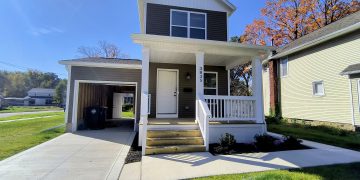
Through the collaboration of local, state and federal agencies, four new homes demonstrate a creative approach to making homeownership more attainable.
“This is evidence that we don’t work in silos,” Conneaut City Manager Nick Sanford said. “You have to have partners in the state and federal government. To aspire to work in silos is to aspire to fail. Without partners, this wouldn’t have been possible.”
Local, state and federal dignitaries celebrated the completion of the Neighbor Next development on Wednesday, Oct. 14.
“It was incredibly rewarding,” Maki-Cliff said. “When you’ve been involved in a project from the early planning stages, through grant applications, financing arrangements, legal agreements, construction and all the unexpected challenges along the way, seeing the finished product is something special.”
“What makes it even more meaningful is knowing who these homes are intended to serve,” Maki-Cliff continued. “Two homes were designated for veterans, and two for individuals and families experiencing housing insecurity. We’re not simply building houses. We’re creating opportunities for stability, independence and homeownership for people who might not otherwise have those opportunities. Seeing four beautiful, energy-efficient homes where there was once an underutilized property was a proud moment for everyone involved.”
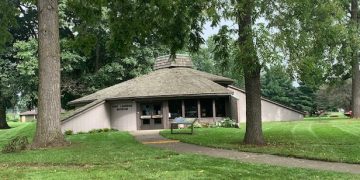
Hayward Park had fallen into disuse, and, in 2021, the City of Conneaut donated the park to the Land Bank. In 2023, the Land Bank submitted a request for funding to subsidize costs and leveraged that against Welcome Home Ohio funds through NOPEC. The city became involved (in the development) through tax incentives.
“I think our predecessors (the previous city council and former City Manager Jim Hockaday) had the forethought to say we were going to be the model, and the way I’d like for it to be referred to in the future as the Conneaut model,” Sanford said. “In the ideal situation, you have vacant developable land whether it was an open lot or had a blighted home that was demolished that, through adaptive reuse, can be developed for affordable housing. That’s what land banks are for.”
The new infill housing development features affordable, energy efficient single-family homes for low-to-moderate income households with a five-year owner-occupancy requirement and 30-year affordability period.
“You’ll see new construction interwoven through the city, especially as you get closer to the lake,” Sanford said. “Infill housing options are available. I would like to have a package that is developer-ready to streamline the permitting phase. An example of that would be a property on Madison Street. We had a house destroyed by fire. It was demolished and the lot is available for $9,000. Infill housing basically says that a house once stood here and another one can stand here under these conditions. What you don’t want is to have 25 properties that are held hostage from being developed.”
The Ashtabula County Land Bank partnered with NOPEC to create a first-of-its-kind energy-efficient housing development. The homes will use modern energy efficient materials and household appliances.
“The Neighborhood Next development really began with a vision from Chuck Keiper, executive director and CEO of NOPEC,” Maki-Cliff said. “Chuck saw an opportunity to bring together energy efficiency, innovative financing and affordable homeownership in a way that hadn’t been done before. The Ashtabula County Land Bank’s mission is to return vacant and underutilized properties to productive use, strengthen our communities and increase our housing stock. This project was a perfect opportunity to accomplish all three.”
Partnerships made the houses affordable.
“Through Ohio’s Welcome Home Ohio grant program, our partnership with NOPEC and the use of Property Assessed Clean Energy (PACE) financing, we were able to create a unique funding structure that made these homes more affordable,” Maki-Cliff said. “The grant funding helped offset construction costs while NOPEC’s PACE financing allowed the energy-efficient improvements to be financed through special assessments on the properties. Property-tax abatements were also incorporated to help offset those assessments and keep homeownership affordable. The treasurer’s office even found a way, with contractual help from the prosecutor, to escrow the PACE loan for one of the homes!”
There were obstacles to completing the project, but solutions were found.
“I especially want to recognize Aaron (Marcovy, chief business development officer) from NOPEC, who was instrumental in moving this project forward,” Maki-Cliff said. “As with any first-of-its-kind initiative, there were obstacles, and Aaron was a driving force in working through those challenges and finding solutions. Chuck had the original vision and Aaron helped make that vision a reality.”
Maki-Cliff said the Neighborhood Next development was truly a collaborative effort that involved NOPEC, the Ashtabula County Land Bank, the City of Conneaut, the Ohio Department of Development, banking and financial partners and many others who worked behind the scenes.
“My daughter’s softball team has a saying that I shared at the ribbon cutting – ‘WE > ME,’” Maki-Cliff said. “‘We is greater than me.’ I think that perfectly describes this project. No single organization or individual could have accomplished this alone. It took everyone bringing their expertise, resources and determination to the table. I’m incredibly proud of what we’ve accomplished, and I hope this is just the beginning of many more innovative housing opportunities throughout Ashtabula County.”
Developments similar to Neighborhood Next are possible throughout the county.
“And that is one of the most exciting aspects of this project,” Maki-Cliff said. “What we’ve accomplished here demonstrates that affordable housing doesn’t have to rely on one funding source or one organization. By bringing together state grant funding, PACE financing, property tax abatements and community partnerships, we’ve created a model that we hope can be replicated in other areas of Ashtabula County, Ohio, and hopefully throughout the country.”
“That doesn’t mean every project will look exactly the same,” Maki-Cliff continued. “Each community and property presents different challenges, and the financing and partnerships have to make sense for that particular development, but we’ve demonstrated that with collaboration and a willingness to think outside the box, we can find creative solutions to some of our county’s housing challenges.”
There is even potential for a similar development in Conneaut.
“We’re very early on in discussions,” Sanford said. “We’re in the high-level phase right now. The school board is considering for submission the old school building on Mill Street, which is a whole block. I think that would be a wonderful opportunity for development. It would be similar to the City of Ashtabula’s renovation of Wenner Field.”
Support authors and subscribe to content
This is premium stuff. Subscribe to read the entire article.


